A calendar can show ten free hours without offering ten usable study hours. Some gaps are too short, some happen when you are exhausted, and some disappear whenever work or care arrangements change. A sustainable course load depends on the kind and reliability of the time available, not simply the total amount that looks unassigned.
This planning exercise is for learners whose responsibilities do not stop at the classroom door. It offers no universal credit recommendation. The right load depends on the courses, your preparation, your circumstances and any conditions attached to enrollment or funding. Use the exercise to prepare a more concrete conversation with an advisor and the people affected by your schedule.
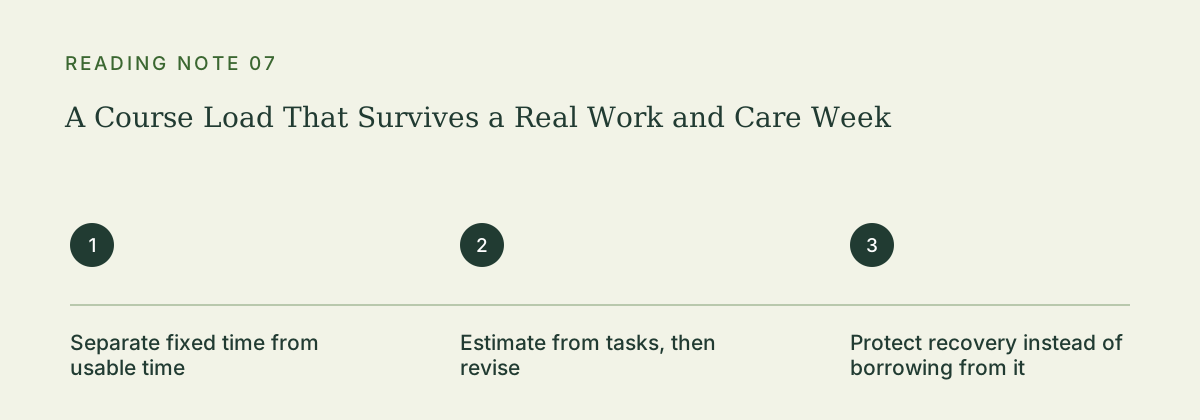
Separate fixed time from usable time
Begin with commitments that cannot casually move: work shifts, travel, care handoffs, appointments and sleep. Include preparation and transition time. A class that ends just before a shift begins may still be impossible if the trip takes half an hour. A study period immediately after a care handoff may not begin reliably at the printed time.
Then identify what each remaining block can support. Short gaps may suit planning, reviewing notes or reading a small section. Longer protected blocks may be needed for writing, complex practice or assessments. Do not assign your hardest work exclusively to moments when you are usually depleted. Capacity includes attention and conditions, not only minutes.
Estimate from tasks, then revise
Look at the specific course's expected work rather than relying on a generic slogan about study hours. Consider reading volume, writing, practice, projects and scheduled participation. If details are incomplete, identify the uncertainty and leave room for adjustment instead of treating the most optimistic estimate as a fact. Ask the instructor or program where to find current expectations.
After the course begins, compare your estimate with actual work. Record the time spent on a representative task and whether it produced the intended understanding. If reading takes longer because the material is new, that is information about the plan. If rereading consumes time without improving comprehension, a study-strategy adjustment may help. The Learning Center's consultation service is one official resource for that kind of question.
Protect recovery instead of borrowing from it
A schedule balanced only by reducing sleep or eliminating every break is fragile. The immediate result may be more hours at a desk, but the quality and sustainability of those hours can deteriorate. Keep basic recovery visible in the plan. You are arranging repeated weeks, not proving that you can survive one unusually intense weekend.
Also leave some capacity unassigned. A buffer is not evidence of laziness; it is space for ordinary variation. Work runs late, children need attention, transportation fails and assignments take longer than expected. A plan that allocates every minute has no way to absorb events that are uncommon individually but predictable collectively.
Make the household arrangement explicit
If study time depends on another person covering a responsibility, discuss the actual task and time. “Help more while I am in school” can mean different things to each person. “Handle this weekly errand during my class period” is concrete enough to evaluate. Confirm the arrangement before counting the time as available.
Include a backup conversation. If the usual care arrangement falls through, which academic tasks can move and which cannot? Is another person genuinely available, or merely someone you hope will be free? You do not need an elaborate contingency for every possibility, but one plausible fallback is stronger than treating an untested assumption as guaranteed support.
Compare course combinations, not isolated courses
Two individually manageable classes can create a difficult combined week. They may both require substantial writing, schedule major projects together or demand group meetings during the same limited evening hours. When possible, compare the pattern of demands across the proposed load. Balance does not mean avoiding challenging work; it means noticing when several kinds of pressure converge.
Online delivery does not automatically solve those collisions. UOnline's semester-based expectations still require attention to course timing. Consider a mix of task types and meeting patterns only within the options available to your program. Do not choose a section solely because its format label sounds flexible; examine the exact obligations as described in the section-fit guide.
Use a disruption test before committing
Walk through a normal week, then remove one important study block. Perhaps a shift changes or a family appointment takes an evening. What happens next? If the only answer is to work through the night, the plan may need more room. If the task can move into a realistic buffer without displacing another essential commitment, the load has more resilience.
Now test a predictable busy period rather than a random emergency. A seasonal work peak or recurring household obligation may be known months ahead. Decide whether the term can accommodate it, whether support can change temporarily, or whether a different start or pace is more realistic. Planning around a known constraint is more effective than treating it as a surprise later.
Choose the tradeoff deliberately
A smaller load may lengthen the path, while a larger load may increase the risk of incomplete work or unsustainable strain. There is no universal answer. Discuss academic sequencing and any enrollment-dependent conditions with the relevant offices, then make the tradeoff using your actual capacity. Do not assume that a private time-management exercise changes university requirements.
The strongest plan is one you can describe honestly: these are the courses, these are the protected study periods, these are the responsibilities that will shift, and this is the fallback when an ordinary disruption occurs. That clarity makes it easier to ask for help, recognize when the plan needs revision and continue learning without pretending the rest of life has disappeared.