After time away from college, the first difficult assignment can seem to confirm every worry about returning. It may instead reveal a smaller, more solvable problem: you understood the lecture but did not practice recall, underestimated the writing time, or scheduled demanding work after an exhausting shift. Start with one assignment and examine what happened before drawing a conclusion about your ability to succeed.
This article offers a practical review method, not clinical advice or a substitute for course instruction. Utah's Learning Center provides free individual learning consultations for currently enrolled students. Those meetings focus on academic success skills rather than teaching course content. Knowing that distinction helps you choose support for the actual obstacle instead of booking help that solves a different problem.
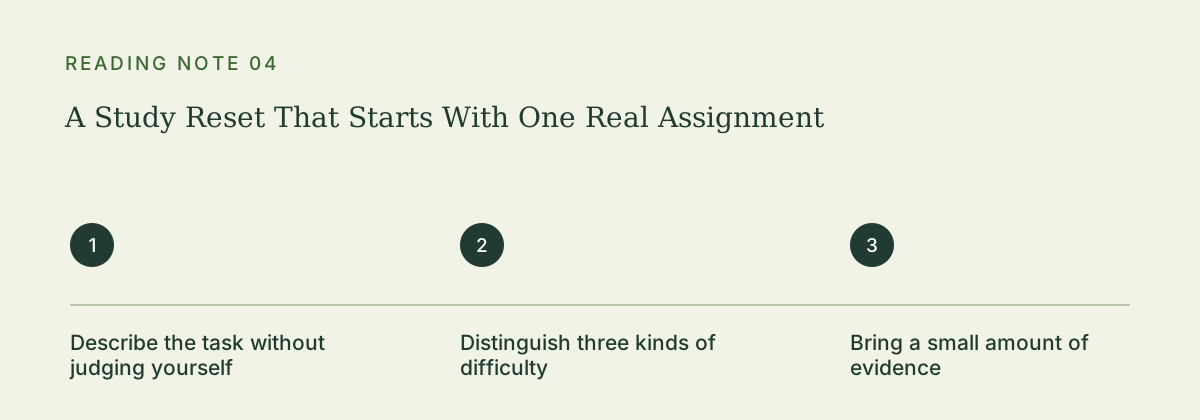
Describe the task without judging yourself
Choose a recent reading, problem set, paper or assessment. Record what the task required, when you started, what you did and where progress stopped. Replace broad statements such as “I cannot concentrate” with an observation such as “I reread the same pages after work but could not explain the argument the next morning.” The second statement gives you something to investigate and change.
Separate effort from method. Spending a long time on a task demonstrates effort, but it does not prove the approach was effective. Highlighting a chapter, copying notes and recognizing familiar examples can feel productive while leaving you unable to apply the material independently. Try checking what you can retrieve or explain without the source in front of you, then identify the gaps that deserve attention.
Distinguish three kinds of difficulty
A content problem means there is a concept, method or instruction you do not understand. Prepare a specific question for the instructor or an appropriate course-support resource. Include what you have attempted and the point where your reasoning stops. Asking “Why does this step follow?” is more actionable than asking someone to explain an entire chapter again.
A study-process problem means your approach does not reliably turn exposure into usable knowledge. You might postpone starting, take notes you cannot use, or practice only the easiest examples. A learning consultation is relevant to this category. A time-capacity problem is different again: even a good method cannot fit unlimited work into a week already filled with nonnegotiable obligations. That calls for a realistic discussion of workload and commitments.
These categories can coexist. For example, uncertainty about a concept may cause avoidance, which then compresses the remaining study time. Start with the obstacle that unlocks the next step. You do not need a perfect diagnosis before asking for help, but a concrete account of the sequence makes the conversation more useful.
Bring a small amount of evidence
For a study-strategy conversation, prepare the assignment instructions, your weekly availability and a short description of what you tried. You do not need to bring an exhaustive history or prove that you worked hard. The purpose is to reveal the pattern. Keep sensitive personal circumstances at the level needed to explain the constraint unless an appropriate official service asks for more.
Name one desired change. Perhaps you want to begin papers earlier, remember readings more reliably, or avoid spending every weekend catching up. A narrow starting goal makes it easier to test a suggestion. “Become a better student” is understandable but difficult to evaluate. “Finish an outline before the final writing session” produces a visible result you can discuss at a later review.
Run a short, realistic experiment
Pick one method to try on the next comparable task. For reading, that might mean pausing after a section to explain the main point from memory. For problem solving, it might mean attempting a new problem before looking at a worked example. For writing, it might mean drafting a claim and a rough structure before polishing sentences. These are general editorial examples, not prescribed University methods.
Choose a setting you can actually repeat. An elaborate routine that requires a silent afternoon you never have will fail for logistical reasons. A smaller routine attached to a dependable study period may provide better evidence. Record whether the change improved understanding, reduced wasted time or made starting easier. Improvement in one area can be useful even if the assignment still feels challenging.
Do not make one support service do every job
The Learning Center distinguishes consultations from tutoring, counseling and accommodations. If the need is course explanation, mental health care or a formal access arrangement, use the appropriate service rather than expecting a study-strategy appointment to replace it. You may use more than one kind of support, but each has its own purpose and process.
A learning plan also cannot override course requirements. If you need clarification about an assessment or a deadline, ask the instructor through the course's established channel. Do not assume that attending a support appointment grants an extension. Keep the academic requirement and the strategy for meeting it visible as separate parts of the plan.
Review what changed, then choose the next move
After the next assignment, compare the experience with your first example. Did you start sooner? Could you explain the material without rereading everything? Did the planned study period actually happen? If the method helped but the time still was not available, the next question is capacity, not a search for a more complicated productivity system.
A useful reset produces a small repeatable improvement and a clearer understanding of the remaining obstacle. It does not require becoming a different person overnight. Return to the next task with evidence about what helps, seek the right support early, and let those observations shape a sustainable approach to the rest of the term.